

The 2-Minute Problem: How Small Manual Tasks Add Up at a Winery
The 2-Minute Problem: How Small Manual Tasks Add Up at a Winery
Two minutes doesn’t sound like a productivity problem.
Neither does checking an order before it ships. Updating a customer record. Comparing two inventory numbers. Exporting a spreadsheet. Fixing an exception before a club release.
Individually, these tasks can seem too small to worry about.
But when the same task happens hundreds or thousands of times a year, a few minutes can turn into weeks of staff time.
For wineries evaluating their technology, that raises an important question:
How much time is your team spending doing work that your systems could be doing for them?
Start with the math
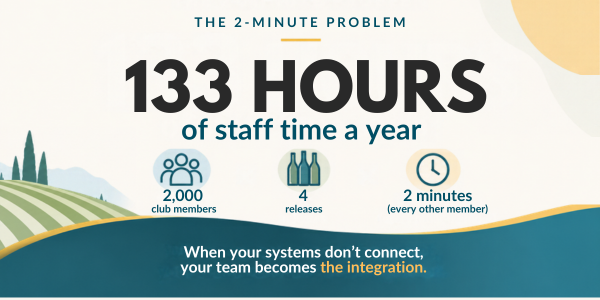
Consider a winery with 2,000 club members and four releases per year.
Suppose half of those members require just two minutes of extra manual work during each release—perhaps checking an address, correcting information, reconciling a record or moving data between systems.
The calculation looks like this:
1,000 members × 4 releases × 2 minutes = 8,000 minutes
That’s approximately:
133 staff hours per year
More than three 40-hour workweeks.
And that’s one task in one part of the winery.
The important number isn’t necessarily 133. Every winery operates differently.
The useful exercise is to find your number.
Where do the extra minutes hide?
Manual work often becomes so familiar that nobody thinks of it as a technology problem.
Your team may simply consider it part of the job.
Here are five places worth examining.
1. Wine club releases
Club processing can involve thousands of small interactions with customer, payment, shipping, inventory and order information.
Ask your team:
- What information do we routinely have to check before processing?
- What gets corrected manually?
- Do we enter the same information in more than one place?
- How many exceptions require someone to investigate?
- After processing, does anything need to be exported, imported or reconciled?
Don’t just count the major problems. Time the routine two-minute fixes.
Those are often where the hours accumulate.
2. Ecommerce orders
An online order should create an order—not a new administrative task.
Look at what happens after someone clicks Buy.
Does a staff member have to check the order in another system? Re-enter customer information? Verify shipping details? Update inventory? Match the customer to an existing record?
Even five minutes can become significant.
For example:
20 orders/day × 5 minutes × 250 days = 25,000 minutes
That’s approximately 417 staff hours.
Of course, that example won’t reflect every winery’s order volume or workflow. The point is to do the calculation using your own numbers.
Where Shopify can help
This is one reason ecommerce integration matters.
A winery may want the modern storefront, merchandising capabilities and evolving commerce technology available through Shopify, while still needing winery-specific systems behind the scenes.
But simply having Shopify and winery software isn’t enough.
The important question is:
What happens to the information after the customer places the order?
A useful Shopify integration should reduce the number of times employees need to manually move, check or reconcile information between ecommerce and winery operations.
When evaluating a Shopify integration, ask specifically what happens to:
Orders → Customers → Products → Inventory → Fulfillment → Wine-club information
“Integrated with Shopify” is less useful than understanding exactly what information moves, in which direction, and what your staff still has to do manually.
3. Inventory
Inventory is another place where tiny delays can create much bigger problems.
Imagine your online store sells the last bottles of a wine tonight.
When the tasting room opens tomorrow, does your team already know they’re gone?
If employees have to check inventory in several places, manually adjust quantities or resolve discrepancies between ecommerce and tasting-room sales, the cost isn’t limited to the minutes spent updating records.
Inaccurate inventory can also affect the customer experience.
A useful question to ask is:
How many times does a person have to touch inventory information between the moment a bottle sells and the moment every relevant system knows about it?
Ideally, the answer is very few.
4. End-of-day reconciliation
Ten minutes at the end of the day sounds harmless.
But:
10 minutes × 250 days = 2,500 minutes
That’s nearly 42 hours a year.
A full workweek spent comparing numbers.
Sales, payments, inventory and accounting are all legitimate things to verify. The question is whether your employee is reviewing information that requires human judgment—or manually compensating for systems that don’t communicate.
Those are two very different kinds of work.
5. Customer information
This one is harder to measure, but potentially just as important.
Suppose the same customer:
- visits your tasting room,
- joins your wine club,
- makes an online purchase,
- attends an event, and
- responds to a marketing campaign.
Does your staff see one customer relationship?
Or does someone have to piece together the story?
Disconnected customer information doesn’t just create administrative work. It can make it harder to recognize your best customers and give them a consistent experience.
Try a 15-minute “manual work audit”
You don’t need a consultant or a major technology project to start finding these costs.
Pick one common workflow—club processing, ecommerce orders, inventory, shipping, accounting or customer updates.
Then ask your team three questions:
1. What do we repeatedly check, copy, re-enter, export, import or reconcile?
2. How long does it take each time?
3. How often do we do it?
Then calculate:
Minutes per task × times performed per year ÷ 60 = annual staff hours
You may discover that a task nobody considered particularly burdensome is consuming dozens—or hundreds—of hours.
Not every manual task should disappear
Automation isn’t automatically better.
Some exceptions require judgment. Some customer interactions deserve personal attention. Some information should be reviewed by a human.
The goal shouldn’t be to eliminate people from winery operations.
It should be to distinguish between work that benefits from a person and work that exists because two systems don’t talk to each other.
A staff member helping a club member choose wines is valuable human work.
A staff member copying the same customer information from one system to another usually isn’t.
Look beyond the integration checklist
When evaluating winery software, it’s tempting to compare features:
Does it integrate with Shopify? Klaviyo? Tock? QuickBooks Online? VinoShipper?
Those are useful questions, but they shouldn’t be the last questions.
Go one step further:
What does the integration actually eliminate?
Ask vendors to walk through a real workflow.
What happens when an online order arrives through Shopify?
What happens when inventory changes?
What happens when a customer updates information?
What happens after a tasting-room purchase?
What information reaches your marketing tools?
What still requires an employee?
That’s where the practical value of connected technology becomes much easier to see.
Your team shouldn’t be the integration
At Activ8 Commerce, this is how we think about connected winery technology.
Activ8 provides the winery-specific operational foundation, while integrations with platforms such as Shopify, Klaviyo, Tock, QuickBooks Online and VinoShipper allow wineries to build a technology stack around their needs.
But the objective isn’t simply to accumulate integrations.
It’s to make information move more effectively so people don’t have to.
Because ultimately, the cost of disconnected software isn’t just another subscription or another login.
It can be two minutes here, five minutes there and ten minutes at the end of every day.
And those minutes add up.
Find your 2-minute problem.
Pick one repetitive workflow this week. Time it. Do the math.
You might discover that one of the best opportunities to give your team more time has been hiding in plain sight.
One connected winery. Built to grow.

- Posted by activ8commerce
- On October 1, 2026
- 0 Comment