


Winery Software in 2026: 12 Things Wineries Should Actually Compare
Choosing a winery DTC software used to be largely about finding a system that could handle the basics: ring up tasting room sales, process a wine club and keep customer records. That list isn’t enough anymore. Today’s winery may sell the same bottle through a tasting room, wine club, ecommerce store and other sales channels. Customers expect their membership benefits and history to follow them. Marketing platforms need useful customer data. Inventory has to stay accurate. And ecommerce itself is changing as AI becomes part of how consumers discover and purchase products. So how should a winery evaluate its technology today? Instead of starting with a long feature checklist, start with what actually happens in your business.
1. What happens when the last bottle sells?
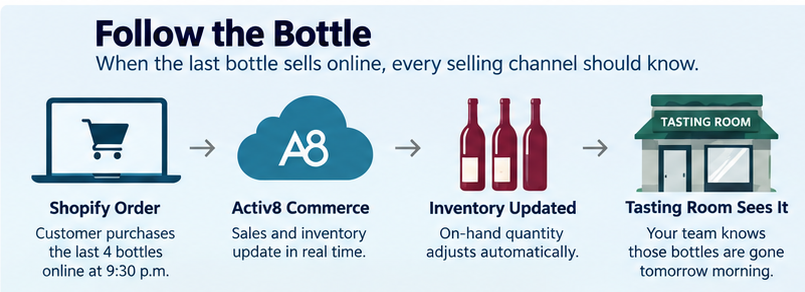
Here’s one of the simplest tests you can give a winery software provider: Your online store sells the last four available bottles of a wine at 9:30 p.m. What does your tasting room see when it opens the next morning? If ecommerce and winery operations don’t share accurate inventory information, someone has to fill the gap. That can mean manual reconciliation, disappointed customers, overselling, unnecessary transfers or staff checking multiple systems before promising that a wine is available. When evaluating software, ask:
- Which system controls inventory?
- How quickly are online and tasting room sales reflected?
- Can inventory be managed by location?
- What happens when an online order is cancelled or changed?
- How are club allocations reflected in available inventory?
- What happens when the same wine is sold through another connected channel?
Don’t settle for “yes, we integrate.” Ask what actually happens to the bottle.
2. Does the customer remain the same customer everywhere?
Imagine a club member walks into the tasting room. Can your staff immediately see that she’s a member? Her benefits? Purchase history? Preferences or previous orders? Now imagine she orders online the following week. Does the ecommerce experience recognize the same relationship? A winery doesn’t really have separate “online customers,” “club customers” and “tasting room customers.” It has customers who interact with the winery in different places. The technology should reflect that. Look closely at how customer records, purchase history, membership information and benefits move between systems. The goal isn’t simply collecting more data. It’s making the data useful at the moment your team—or your customer—needs it.
3. Is the tasting room POS actually built for a tasting room?
A tasting room isn’t simply a retail counter that happens to sell wine. Guests arrive with reservations. They sit at tables. Tastings begin before purchases are made. Tabs stay open. Club members receive benefits. Someone may join the club during the visit. Another guest may purchase wine now but schedule a pickup later. A generic point-of-sale system can process a credit card. That’s different from supporting the experience around the transaction. Ask whether your system can support the way your tasting room actually operates, including:
- reservations
- table seating
- open tabs
- tastings
- club-member recognition
- membership signups
- discounts and benefits
- scheduled pickups
- customer history
Then ask an even better question: How many different screens or systems does an employee have to use to complete one guest’s visit? That’s often where the real difference becomes visible.
4. How much work does a club release actually require?
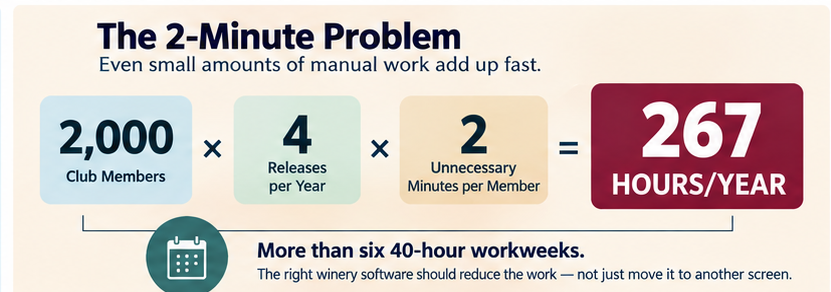
Wine club software shouldn’t just be capable of charging credit cards. Think through an entire release. Which wines are available? Who receives what? Can members customize? Are allocations controlled? Are benefits applied correctly? Is inventory reserved? Which orders ship and which are picked up? What happens when a payment fails? What information goes to fulfillment? What customer communication follows? Now count the places where your staff exports a spreadsheet, re-enters information, switches systems or manually checks something. Those steps matter. For a 2,000-member club running four releases a year, even two minutes of unnecessary manual work per member per release adds up to more than 266 staff hours annually. That’s more than six 40-hour workweeks. The number will be different for every winery, but the calculation is useful: Club members × releases per year × avoidable minutes per member ÷ 60 = annual staff hours Software should reduce that number—not simply move the work to another screen.
5. Can ecommerce evolve without replacing your winery platform?
This is becoming one of the most important technology questions wineries can ask. Historically, wineries often faced a compromise: choose highly specialized winery software and accept its ecommerce capabilities, or choose a major ecommerce platform and then figure out how to handle winery-specific operations. That doesn’t have to be the choice. Activ8 Commerce takes a connected approach: Activ8 handles winery-specific operations while integrating with Shopify for ecommerce. Why does that distinction matter? Because ecommerce is changing extremely quickly. Shopify reported that in Q1 2026, traffic to Shopify stores from AI sources grew more than 8x year over year, while orders attributed to AI-powered searches grew nearly 13x. Consumers are beginning to discover and evaluate products through AI conversations rather than only through traditional search engines and websites. Shopify is building infrastructure specifically for this change, including Shopify Catalog and Agentic Storefronts, which are designed to make product information available to AI shopping channels. For wineries, the strategic question isn’t simply, “Do we have an online store?” It’s increasingly: “Is our ecommerce platform being built for how people may shop next?”
6. Is your product information ready for AI discovery?
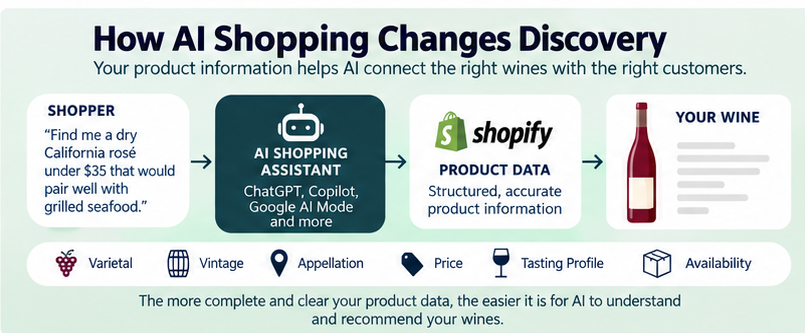
Search engines taught businesses to think about keywords. AI shopping introduces another consideration: can a machine clearly understand what you’re selling? Consider the difference between: 2024 Estate Rosé and useful product information that helps communicate:
- varietal
- vintage
- appellation
- tasting profile
- price
- food pairings
- availability
- bottle size
- shipping eligibility
- other relevant product attributes
A customer might not search for your winery by name. They might ask an AI shopping assistant: “Find me a dry California rosé under $35 that would pair well with grilled seafood.” Shopify says its Catalog structures product information—including descriptions, images, pricing, inventory and shipping information—so connected AI platforms can understand and surface products. That makes the quality and structure of product data increasingly important. Your ecommerce platform shouldn’t only make products attractive to people browsing your website. It should also help make those products understandable to the new systems helping people decide what to buy.
7. Can marketing use what you know about the customer?
Collecting customer data and using customer data are two very different things. A winery may know that someone:
- belongs to a particular club
- buys Cabernet frequently
- hasn’t purchased in six months
- usually picks up rather than ships
- recently placed a large ecommerce order
Can your marketing technology do something useful with that information? This is where integrations with platforms such as Klaviyo become important. Instead of treating email marketing as a separate database, connected systems create opportunities for more relevant segmentation, automation and personalization. The question to ask isn’t simply: “Does it integrate with Klaviyo?” Ask: “What information can I actually use in Klaviyo because of the integration?” That’s a much more revealing question for any integration.
8. How many plugins and workarounds are required?
Sometimes a platform appears inexpensive or simple until you start recreating the capabilities the winery actually needs. Ask prospective vendors what requires:
- an additional plugin
- another software subscription
- custom development
- middleware
- manual exports
- separate support
- transaction fees
- additional setup or maintenance
This doesn’t mean third-party technology is bad. Quite the opposite: a strong ecosystem gives wineries choice. The distinction is between intentional integrations that add capability and patches required to make basic workflows function. A useful buying question is: “Show me the complete technology stack I would need—not just your software.” Then compare the whole picture.
9. Who owns the relationship when systems connect?
Integrations look impressive on a diagram. The real test comes when something doesn’t work. If an order originated online but inventory didn’t update correctly, who investigates it? If customer information isn’t flowing to the marketing platform, which company provides support? If an integration changes, who maintains it? Before buying, ask who built each important integration, how data moves, who supports it and what happens when one of the connected platforms changes. A technology ecosystem is only valuable if the connections themselves are dependable.
10. Can the system grow without forcing you to start over?
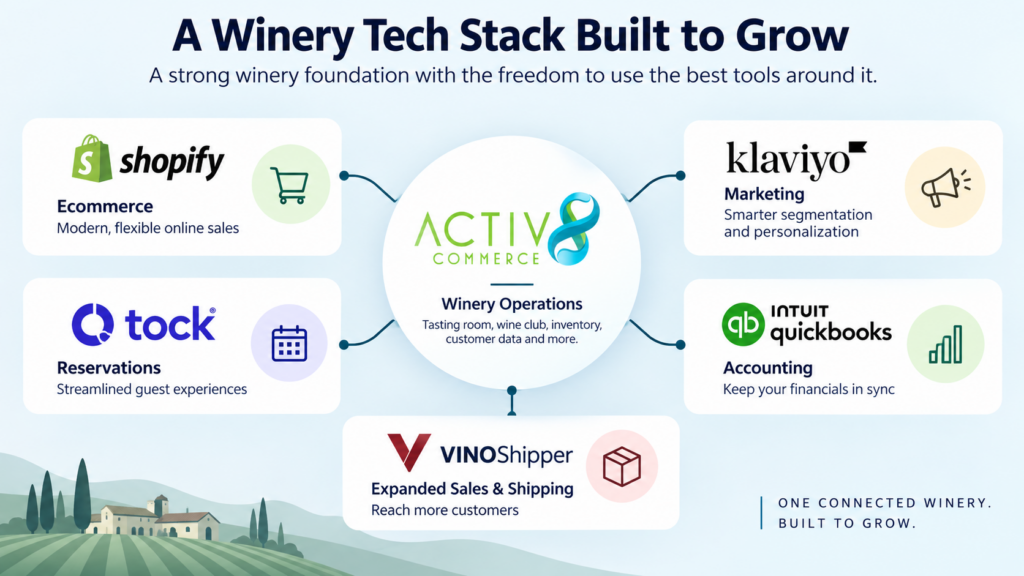
A winery’s needs change. You may not need sophisticated marketing automation today. You might next year. You may add reservations, expand your club, change accounting workflows, open another location or invest much more heavily in ecommerce. Replacing the core winery platform every time the business evolves is expensive and disruptive. Look for a system that can serve as a stable operational foundation while allowing specialized technology to be added where it makes sense. At Activ8, that’s why integrations with platforms including Shopify, Klaviyo, Tock, QuickBooks Online and VinoShipper are an important part of the strategy. The goal isn’t to make every piece of technology ourselves. It’s to give wineries a strong operational core while preserving the ability to choose powerful tools around it.
11. What will your staff actually have to do every day?
Feature demonstrations tend to show the happy path. Buying decisions should investigate the ordinary path. Ask a vendor to show you: A club member arrives without a reservation. What happens? An online order needs to be changed. What happens? A card fails during a club release. What happens? Someone joins the club during a tasting. What happens? An order will be picked up instead of shipped. What happens? Count clicks. Count screens. Count systems. Notice where information has to be entered twice. Those everyday workflows can matter more than an impressive feature you’ll use twice a year.
12. Are you buying for today’s winery—or the next five years?
No software provider can predict exactly what winery commerce will look like five years from now. But you can evaluate whether the platform you’re considering gives you room to adapt. Look at its integrations. Look at the technology it connects to. Ask how new sales channels are handled. Ask about APIs and data access. Ask how quickly important integrations evolve when their partner platforms change. And increasingly, ask about AI—not because every winery needs an “AI strategy” today, but because AI is becoming part of the commerce, marketing and discovery platforms wineries already use. Shopify, for example, now supports shopping through AI channels including ChatGPT, Microsoft Copilot, Google AI Mode and Gemini for eligible merchants and buyers. Its AI assistant, Sidekick, can also work with commerce data to help merchants analyze performance, create content and perform administrative tasks. That’s a very different conversation from simply adding an AI chatbot to a winery website. The underlying commerce infrastructure is changing. Your winery technology should give you a way to change with it.
The Better Winery Software Question
There may not be one piece of software that should do absolutely everything. That’s actually the point. The better question isn’t: “Which winery software has the longest feature list?” It’s: “Which technology gives us the strongest winery-specific foundation—and lets us connect the best tools for everything else?” When evaluating a platform, follow an actual bottle through the business. Follow an actual customer. Follow a club release. Follow an ecommerce order. Follow the data into marketing, accounting, shipping and fulfillment. Wherever someone has to manually bridge the gap, you’ve found something worth asking about. Because the best winery technology shouldn’t simply have more features. It should make the winery work better.
See Activ8 Commerce in action
Activ8 Commerce brings tasting room, wine club, customer management, inventory and winery operations together while connecting with technologies including Shopify, Klaviyo, Tock, QuickBooks Online and VinoShipper.
One connected winery. Built to grow.
Fall Offer: Sign up by October 31, 2026, and setup fees for Activ8 Commerce, Tock, QuickBooks Online and VinoShipper integrations are waived.*
*Shopify integration setup is not included in this promotion. Additional hourly setup or service fees, if applicable, are not included.

- Posted by activ8commerce
- On September 17, 2026
- 0 Comment