

What Will Your Winery Do Differently in 2027?
Winery Technology Planning for 2027: 5 Questions Every Winery Should Ask
The wine market is changing. Here’s how to make sure your winery’s technology is ready for what’s next.
The 2026 harvest is wrapping up. Another vintage is underway, and wineries are beginning to think about what comes next.
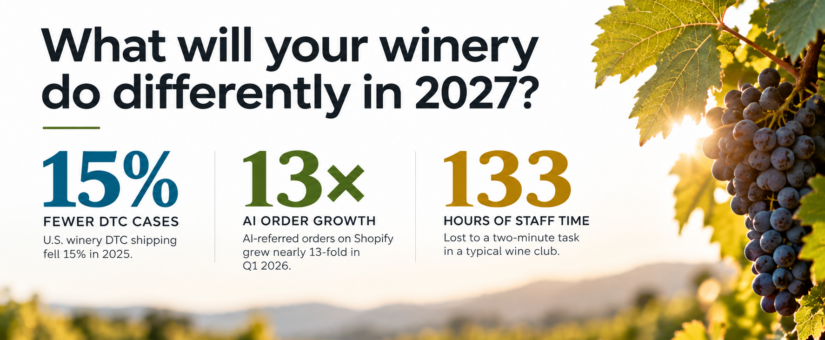
Before making your technology plans for 2027, consider three numbers:
- 15%: The decline in U.S. winery direct-to-consumer shipping volume in 2025.
- Nearly 13×: The year-over-year growth in orders attributed to AI-powered searches reported by Shopify in Q1 2026.
- 133 hours: The annual staff time a winery with 2,000 club members and four releases could spend on just two minutes of unnecessary work for every other member.
The first two reflect broader market developments. The third is an illustrative calculation, but it highlights something wineries can actually control.
Together, they point to an important question:
Is your winery technology helping you adapt to a changing market—or making it harder?
1. Is Your Ecommerce Ready for How Customers Will Shop in 2027?
Online wine shopping is evolving, and not just because customers expect attractive websites and easy checkout.
AI-assisted product discovery is creating new ways for consumers to find products.
A shopper might ask an AI assistant:
“Find me a dry California rosé under $35 that pairs well with seafood.”
For wineries, that raises questions about how clearly their wines are represented online.
Does your store provide detailed product descriptions, accurate availability, varietals, vintages, appellations, tasting notes and food pairings?
Can customers easily find what they’re looking for and complete a purchase?
And can your ecommerce platform keep evolving as shopping technology changes?
Why Shopify matters
Shopify is investing heavily in ecommerce innovation, including AI-assisted product discovery and shopping experiences.
But wineries have operational requirements that ordinary retailers don’t.
Wine clubs, tasting rooms, inventory, customer records and alcohol-specific workflows all need to be considered.
Activ8 Commerce + Shopify brings these two worlds together through native, bidirectional synchronization.
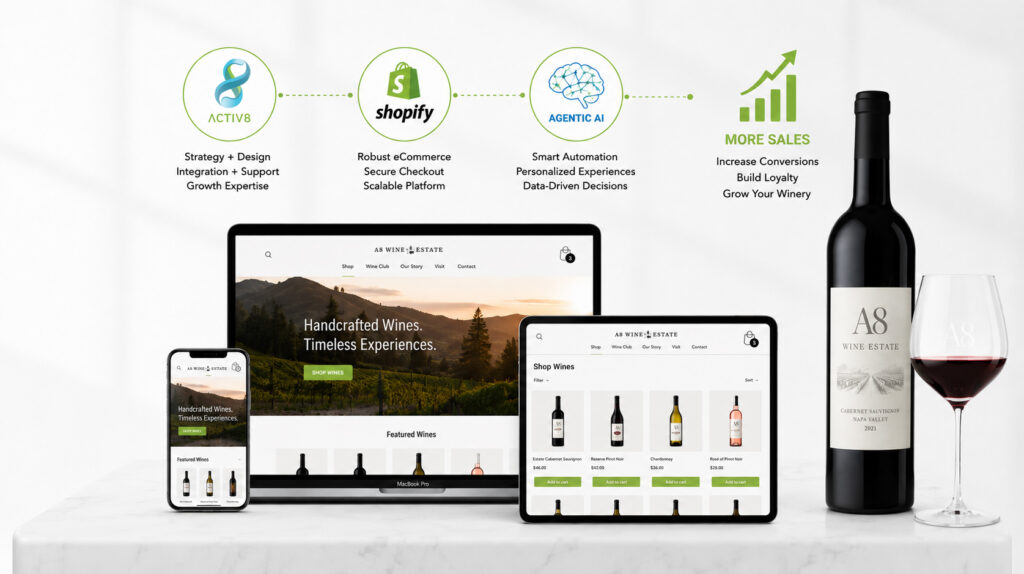
Rather than treating Shopify as a separate storefront connected by a basic order handoff, Activ8 allows wineries to combine Shopify’s advanced ecommerce environment with the winery-specific operations managed in Activ8.
For wineries evaluating ecommerce software in 2027, this opens up a different possibility: modern ecommerce without giving up the operational platform built for their business.
Question to ask: Does our ecommerce platform give us room to grow, and how deeply does it synchronize with the rest of our winery?
2. How Much Time Is Your Winery Losing to Manual Work?
Two minutes doesn’t sound like much.
But consider a winery with 2,000 wine club members and four releases per year.
If just half those members require two minutes of unnecessary manual work per release—checking information, correcting records or reconciling discrepancies—that adds up to approximately 133 staff hours annually.
That’s more than three 40-hour workweeks spent on one small task.
Now think about other repetitive activities:
- Re-entering ecommerce orders
- Checking inventory across sales channels
- Reconciling daily transactions
- Correcting wine club records
- Exporting and importing customer information
- Manually moving information between shipping, compliance and accounting systems
Not every manual task can or should disappear. Personal service and human judgment remain essential to winery hospitality.
But tasks that exist only because systems don’t communicate deserve a closer look.
Try a 15-minute workflow audit
Choose one repetitive task your team performs.
Record how many minutes it takes and how often it happens.
Then calculate:
Minutes per task × Annual frequency ÷ 60 = Annual staff hours
You may be surprised how much time a seemingly insignificant task consumes.
Question to ask: Which repetitive task should our winery no longer be doing in 2027?
3. Is Your Tasting Room POS Actually Built for Winery Hospitality?
A tasting room isn’t a conventional retail store.
Guests may arrive for a seated tasting, purchase bottles, use wine club benefits or decide to become members.
Staff need technology that supports the experience rather than interrupting it.
A winery-specific POS should accommodate the way tasting rooms actually operate.
For example, Activ8 Commerce provides tools for:
- Tasting-room sales
- Table seating and service
- Wine club management
- Complimentary tasting benefits
- Customer management
- Winery inventory
These capabilities matter because hospitality is about more than processing a payment.
A generic retail POS may be excellent at transactions but still require additional processes to accommodate winery-specific needs.
Question to ask: Does our POS support the way our tasting room actually works, or are we adapting our hospitality to the limitations of the software?
4. Is Your Winery Technology Stack Connected—or Just Complicated?
A modern winery may use different technology for ecommerce, marketing, reservations, shipping, compliance, accounting, wholesale and multi-location inventory.
There’s nothing inherently wrong with that.
Specialized tools can be valuable.
The challenge is making sure information moves efficiently between them.
Consider an online wine order.
Does the order flow to the appropriate systems?
Does inventory remain accurate?
Does customer information stay connected?
Can the shipping and compliance processes access what they need?
Does accounting receive accurate transaction information?
Can relevant purchase data inform future marketing?
Or does someone on your team have to move information manually?
Look beyond the integration checklist
When evaluating winery management software, don’t stop at asking whether a vendor integrates with a particular platform.
Ask:
What information actually moves?
In which direction?
How frequently?
What happens when something changes?
Which tasks will our staff still need to perform?
These questions are particularly important when evaluating ecommerce connections.
Activ8’s native, bidirectional Shopify synchronization deserves special attention because ecommerce touches so many areas of winery operations.
Other specialized connections can support areas such as marketing, reservations, accounting and shipping.
The goal isn’t necessarily fewer systems.
It’s fewer gaps between them.
Question to ask: Are our systems reducing work for our team—or creating work between them?
5. Are You Buying Software for Today—or Building for the Next Five Years?
Changing winery software can be a significant undertaking.
That makes it tempting to focus primarily on the immediate problems: replacing an outdated POS, improving the online store or simplifying wine club management.
Those needs matter.
But technology decisions should also account for where the winery wants to go.
Will you expand your ecommerce business?
Add tasting experiences or locations?
Develop new club offerings?
Improve customer retention?
Use more sophisticated marketing?
Take advantage of emerging shopping channels?
Your technology should make those possibilities easier—not force another major system change when you’re ready to pursue them.
That doesn’t mean predicting exactly what ecommerce or the wine industry will look like in five years.
It means choosing a flexible foundation that can evolve.
Question to ask: Will our winery software support the business we’re trying to become?
Your 2027 Winery Technology Checklist
Before finalizing next year’s technology plans, identify three priorities:
One customer experience to improve.
Perhaps it’s online shopping, checkout, tasting-room service or wine club membership.
One repetitive task to eliminate.
Find a process that consumes staff time without adding value to the customer experience.
One technology limitation to overcome.
Identify the system, workflow or missing connection that’s preventing your winery from moving forward.
Then ask your technology providers to demonstrate how they would address those priorities using real winery scenarios.
A feature list is useful.
A demonstration of how your winery would actually operate is better.
The Next Vintage Is Already Underway. What’s Your Plan?
The wine industry can’t control every market challenge.
But wineries can make meaningful decisions about how they sell, serve customers and operate.
At Activ8 Commerce, we believe winery technology should provide a strong operational foundation while giving wineries access to specialized tools and modern ecommerce capabilities.
That’s why we’ve invested in native, bidirectional synchronization with Shopify—bringing together winery-specific operations and an ecommerce platform built to keep evolving.
As you look toward 2027, don’t just ask whether your current software still works.
Ask what your winery could accomplish if its technology worked better.
One connected winery. Built to grow.
Sources: Sovos ShipCompliant/WineBusiness Analytics, 2026 Direct-to-Consumer Wine Shipping Report; Shopify, Q1 2026 AI commerce data. The 133-hour example is an illustrative calculation, not an industry average.

- Posted by activ8commerce
- On October 24, 2026
- 0 Comment