

Winery DTC Shipments Fell 15%. What Should Your Technology Be Doing About It?
Selling wine directly to consumers got harder in 2025.
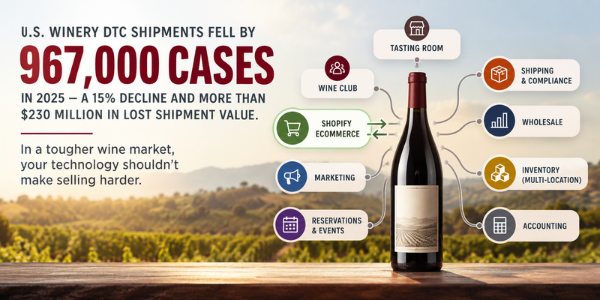
According to the 2026 Direct-to-Consumer Wine Shipping Report from Sovos ShipCompliant and WineBusiness Analytics, U.S. wineries shipped 967,000 fewer cases directly to consumers in 2025 than the year before.
Shipment volume declined 15%, representing more than $230 million in lost DTC shipment value.
Those numbers reflect a challenging wine market. But they also raise an important question for individual wineries:
When every sale matters more, is your technology making it easier—or harder—to make that sale?
Because selling a bottle of wine isn’t nearly as simple as it looks.
Follow one bottle
Imagine a customer discovers one of your wines online.
Before that bottle reaches the customer, a surprising number of things may need to happen.
Can the customer easily buy it online?
Can you legally ship wine to their state?
What taxes and fees apply?
Is the wine actually available?
Is that inventory also being sold in your tasting room, allocated to your wine club, available wholesale or stored at another location?
Does your fulfillment or shipping system receive the information it needs?
Does the purchase become part of the customer’s history?
Can your marketing system use that purchase to communicate more intelligently with the customer later?
Does the transaction reach accounting without someone entering it again?
The customer sees one bottle.
Behind it may be an entire technology stack.
A winery isn’t just a retailer
That’s part of what makes winery technology unusually complicated.
A winery may simultaneously operate as a:
- Tasting room
- Wine club
- Ecommerce business
- Marketing operation
- Shipping operation
- Regulated alcohol business
- Events and reservations business
- Wholesale business
- Multi-location inventory operation
And each function can have legitimate reasons for using specialized technology.
The answer isn’t necessarily to eliminate those systems.
It’s to make sure they work together.
The real problem isn’t how many systems you have
A winery might use excellent software for accounting, another platform for reservations and another for marketing.
That’s not inherently inefficient.
The problems begin when employees become responsible for moving information between them.
Export this.
Import that.
Enter the customer again.
Check whether inventory matches.
Correct an order.
Update a spreadsheet.
Reconcile yesterday’s transactions.
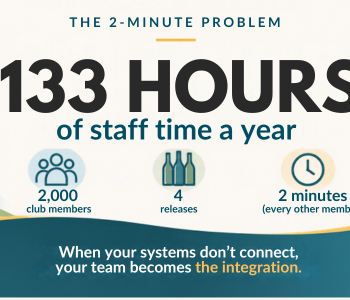
We’ve written before about what we call the “2-minute problem.”
A tiny manual task may seem insignificant until you multiply it across hundreds of customers, transactions or club members.
The same principle applies to your entire technology stack.
So instead of asking:
“How many systems are we using?”
Try asking:
“How many times does a person have to move information between them?”
That’s a much better measure of whether your winery technology is actually connected.
Ecommerce deserves special attention
Ecommerce is becoming too important—and changing too quickly—to treat it as simply another box on a winery software feature list.
Customers expect the shopping experiences they encounter everywhere else online.
Meanwhile, ecommerce itself is evolving through personalization, automation, new payment experiences and increasingly AI-assisted product discovery and shopping.
That’s one reason Activ8 took a different approach with Shopify.
Activ8 + Shopify goes beyond a conventional integration
Rather than trying to recreate everything a global ecommerce platform can do inside winery software, Activ8 allows wineries to use Shopify for what Shopify does best while Activ8 manages the winery-specific operations behind it.
And the connection isn’t simply a basic one-way handoff.
Activ8 and Shopify provide native, bidirectional synchronization.
That distinction matters.
Orders and information shouldn’t simply leave one system and disappear into another. The two environments need to stay synchronized so wineries can take advantage of Shopify’s ecommerce capabilities without separating the online store from the rest of the winery.
For wineries evaluating ecommerce technology, that leads to a better question than:
“Do you integrate with Shopify?”
Ask:
“Exactly what synchronizes with Shopify, in which direction, and what will my staff still have to do?”
The answer tells you much more about the actual integration.
Marketing belongs in the technology conversation too
Marketing is sometimes treated as something that happens after the operational systems are chosen.
But customer data is one of the most valuable outputs of those systems.
What did someone purchase?
Are they a club member?
When did they last visit?
What wines do they prefer?
How frequently do they buy?
Did they shop online, in the tasting room or both?
A marketing platform such as Klaviyo becomes considerably more useful when relevant customer and purchase information can reach it.
The goal isn’t simply to send more email.
It’s to use what your winery already knows to communicate more intelligently.
That makes marketing connectivity part of the technology architecture—not simply a marketing department concern.
Shipping and compliance can’t be an afterthought
Wine ecommerce also has a complication most ordinary online retailers don’t face:
You can’t necessarily sell and ship every product to every customer everywhere.
Compliance, shipping rules, taxes, fulfillment and carrier requirements can all influence what happens after a customer decides to buy.
Wineries may use specialized systems and services to handle these functions—and that’s precisely why connectivity matters.
A beautiful online checkout isn’t much help if employees then have to manually reconstruct the order somewhere else to fulfill it correctly.
Don’t forget wholesale and multiple locations
Inventory becomes even more complicated when the same wine can potentially be sold through:
Ecommerce + tasting room + wine club + wholesale + multiple winery locations
The important question isn’t simply whether your software has an inventory screen.
It’s:
How quickly does every relevant part of the business know that a bottle is no longer available?
The closer that answer gets to real time—and the less human intervention it requires—the less opportunity there is for overselling, discrepancies and unnecessary staff work.
Accounting is another place to look for hidden work
Accounting integrations may not make exciting marketing copy.
But ask the employee who has to reconcile transactions manually whether they matter.
Your winery software doesn’t need to become your accounting software.
It does need to provide your accounting system with the information it needs as efficiently and accurately as possible.
Again, specialization isn’t the enemy.
Disconnected specialization is.
A better way to evaluate your winery technology stack
Instead of starting with a long feature checklist, take several real transactions and follow them through your winery.
Follow:
One ecommerce order.
One tasting-room purchase.
One club shipment.
One inventory adjustment.
One new customer.
For each one, ask:
Where does the information originate?
Which systems need it?
Does it move automatically?
Does it move both ways when necessary?
Does someone have to re-enter it?
Does someone have to check that two systems agree?
Can marketing use the information afterward?
Does accounting receive what it needs?
Does inventory remain accurate everywhere?
Those answers will tell you far more about your technology than the number of features on a sales sheet.
Your winery software should be the foundation—not another silo
That’s the philosophy behind Activ8 Commerce.
Activ8 provides the winery-specific operational foundation for areas such as tasting room, wine club, customers and inventory.
Specialized technology can then do what specialized technology does best.
That can include tools for reservations, marketing, accounting, shipping, compliance and other winery needs.
And for ecommerce, Activ8 + Shopify provides a native bidirectional synchronization designed to give wineries access to Shopify’s evolving ecommerce ecosystem without disconnecting ecommerce from winery operations.
The goal isn’t to put everything into one piece of software.
And it isn’t to collect as many integrations as possible.
The goal is to make the winery work better.
The wine market is already asking wineries to work harder for every customer and every sale.
Your technology shouldn’t add to that workload.
It should help remove it.
One connected winery. Built to grow.
Source: Sovos ShipCompliant & WineBusiness Analytics, 2026 Direct-to-Consumer Wine Shipping Report.

- Posted by activ8commerce
- On October 8, 2026
- 0 Comment